
From Vision to Implementation: Donnalee Lozeau on Transforming Rural Health in New Hampshire
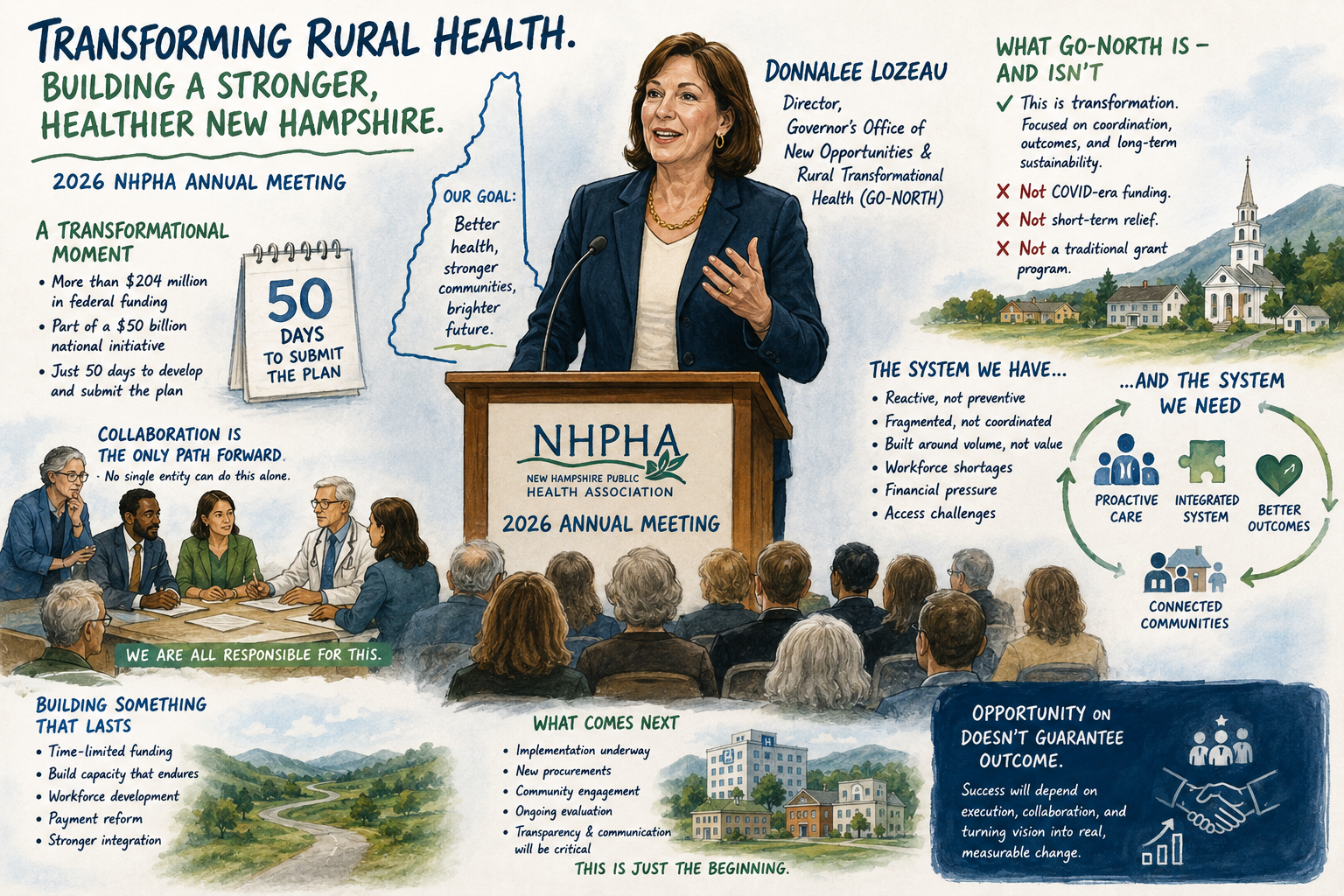
At the 2026 Annual Meeting of the New Hampshire Public Health Association, keynote speaker Donnalee Lozeau brought something the moment demands: clarity, candor, and a deep understanding of how systems actually work.
Lozeau, Director of the Governor’s Office of New Opportunities & Rural Transformational Health (GO-NORTH), has spent decades in public service, beginning at age 24 in the New Hampshire House of Representatives, serving eight terms, rising to Deputy Speaker, and later becoming Nashua’s first female mayor from 2007 to 2015. Her career has consistently sat at the intersection of policy, community development, and real-world implementation. That perspective was evident throughout her remarks.
A Transformational Moment—With Real Pressure
At the center of Lozeau’s keynote was New Hampshire’s Rural Health Transformation Program, backed by more than $204 million in federal funding as part of a $50 billion national initiative administered through CMS.
But if the scale of the opportunity is historic, so is the pressure.
The state had just 50 days to develop and submit its plan. That process required input from hospitals, community health centers, EMS providers, behavioral health organizations, and local communities across New Hampshire. It was fast, complex, and, as Lozeau made clear, far from perfect.
“This is not simple work,” she said, emphasizing both the urgency and the complexity of what lies ahead.
What GO-NORTH Is—and What It Isn’t
One of the most important themes of the keynote was defining the program itself. This is not COVID-era funding. It is not short-term relief. And it is not a traditional grant program designed to fund existing efforts.
“This is transformation,” Lozeau emphasized, focused on coordination, outcomes, and long-term sustainability.
That distinction matters. The goal is not to patch gaps, but to fundamentally shift how care is delivered across rural New Hampshire.
The System We Have—and the One We Need
Lozeau did not shy away from describing the current system.
It is reactive rather than preventive. Fragmented rather than coordinated. Built around volume instead of value. Workforce shortages, financial pressure on providers, and access challenges in rural communities continue to define the landscape. None of that was news to the audience.
What was different was the framing: this moment represents an opportunity to move from that system to one that is proactive, integrated, and centered on long-term outcomes.
The vision is straightforward, even if the path is not—more coordinated care, earlier intervention, and stronger connections between clinical services and community-based supports.
Building Something That Lasts
A central tension in Lozeau’s remarks was sustainability. The funding is significant, but it is time-limited. The work must outlast the dollars.
That requires not just investment, but discipline. The program cannot be used to expand systems indiscriminately or replace existing funding. It must build capacity that can endure, through workforce development, payment reform, and stronger integration across sectors.
Success will be measured not just by how much money is spent, but by whether it leads to fewer avoidable hospital visits, more stable providers, and measurable improvements in population health.
Collaboration as the Only Path Forward
If there was one message that carried through the keynote, it was this: no single entity can do this alone. The state’s success in securing the funding was driven by collaboration, and that same approach will determine whether the effort succeeds.
GO-NORTH itself was designed to reflect that reality, structured as a nimble, independent entity within the Governor’s office, but deeply connected to partners across government, healthcare, education, and community organizations.
“We are all responsible for this,” Lozeau said, underscoring the shared nature of the work ahead.
Managing Expectations—and Staying Engaged
Lozeau was equally clear about the challenges.
Not every idea can be funded. Not every need can be met immediately. And not every expectation will align with what the program is designed to do. But she encouraged those in the room—and across the state—to stay engaged, stay curious, and stay involved. Because this is not a finished plan. It is a process unfolding in real time.
What Comes Next
Implementation is already underway, with key partners, including the Community Development Finance Authority, the Community College System, the University System of New Hampshire, and others, beginning to operationalize the work.
New procurements, community engagement, and ongoing evaluation will shape the next phase. Transparency and communication, Lozeau emphasized, will be critical.
“This is just the beginning,” she noted.
For public health professionals, the significance of this moment is clear.
The Rural Health Transformation Program represents one of the most substantial investments in New Hampshire’s healthcare system in decades. It offers a rare opportunity to address long-standing challenges—access, workforce, coordination, and cost, with a level of resources and focus that is not often available.
But opportunity does not guarantee outcome.
The success of this effort will depend on execution, collaboration, and the ability to translate a complex vision into real, measurable change in communities across the state.
That is the work ahead.