
New Hampshire is not lacking in vision when it comes to improving health.
New Hampshire is not lacking in vision when it comes to improving health.
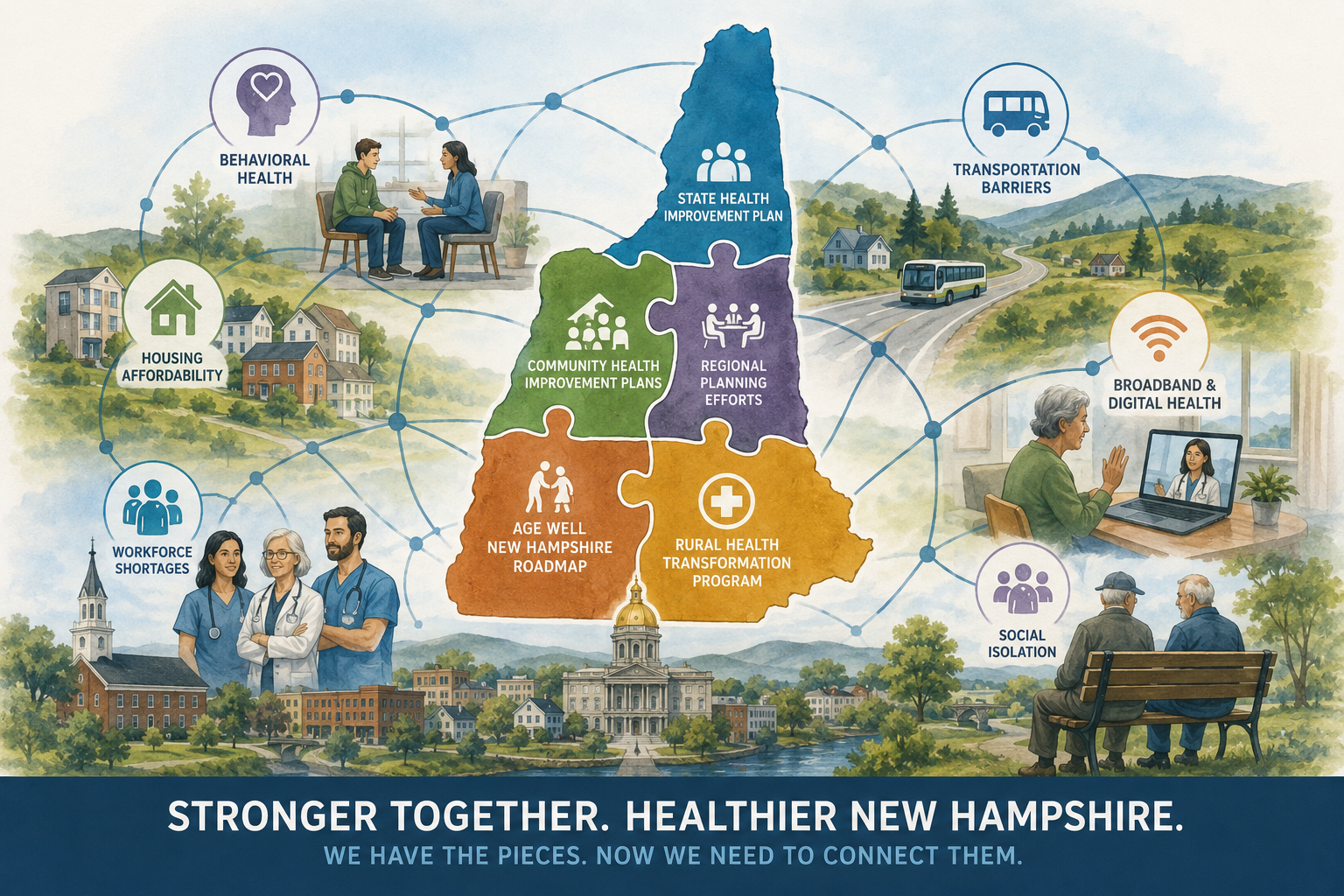
Across the state, there is no shortage of plans, each local, data-driven, and rooted in the needs of our communities. The State Health Improvement Plan, community health improvement plans, regional planning efforts, the Age Well New Hampshire roadmap, and now the Rural Health Transformation Program all point in the same direction: toward a healthier, more equitable future.
But when we step back and look across these efforts, a different picture begins to emerge.
We are doing a lot of good work. Just, we are not always doing it together.
At the New Hampshire Public Health Association, we recently examined these plans side by side—not to critique them, but to better understand how they align and where there may be opportunities to strengthen their collective impact.
What we found is both encouraging and instructive.
There is strong agreement on the challenges we face. Behavioral health continues to be a priority across nearly every plan. Housing affordability consistently ranks at or near the top. Workforce shortages are widely acknowledged, often tied directly to the rising cost of living. Transportation barriers remain a persistent obstacle, particularly in rural communities.
These are not new insights, but their consistency matters.
Where the challenge lies is in how these issues are addressed across systems.
Housing is recognized as a key driver of health outcomes, yet it is not consistently integrated into community health strategies. Transportation is identified as a barrier, but solutions are often fragmented. Broadband and digital health, now essential to care delivery, are largely absent from many local plans, in part because those plans were developed before these issues came to the forefront. Social isolation, a growing and measurable public health risk, is unevenly addressed across communities.
These gaps are not the result of inaction. They are the result of a system that has evolved quickly, sometimes faster than our planning processes can keep up.
At the same time, New Hampshire is entering a period of significant investment. Through the Rural Health Transformation Program, more than $200 million will be deployed over the next five years to expand access, strengthen the workforce, and modernize care delivery.
This is also an extraordinary opportunity. But it also raises an important question: will these investments reinforce the system we have—or help us build the system we need?
Historically, much of our work has followed a “hub-and-spoke” model, where services and decision-making are centered in one place and extended outward. That model has served us in important ways, but it does not fully reflect the complexity of today’s challenges.
What we need now is a statewide network. A networked system allows for movement, collaboration, and shared ownership. It recognizes that organizations may lead in one area and support in another. It creates space for local knowledge to inform statewide priorities—and for statewide resources to reach communities more effectively.
In a network, the question is not just “Who is responsible?” but “Who is connected?”
That shift is important: Because the challenges we face—whether it is housing, workforce, transportation, or access to care—do not exist in isolation. They intersect. And if our solutions are not connected, their impact will be limited.
New Hampshire has strong foundations. We have engaged leaders, committed communities, and a clear understanding of the issues that matter most.
The next step is coordination: Not more siloed plans; Better alignment; Stronger connections.
If we can do that, if we can ensure that our efforts are not just aligned in intention, but integrated in practice. We have a real opportunity to improve health outcomes across the state.
We have the pieces. Now we need to connect them.
Tory Jennison, PhD, RN
Executive Director, New Hampshire Public Health Association